Neuromyelitis optica or Devic’s disease
GENERAL ASPECTS
WHAT IS NEUROMYELITIS OPTICA?
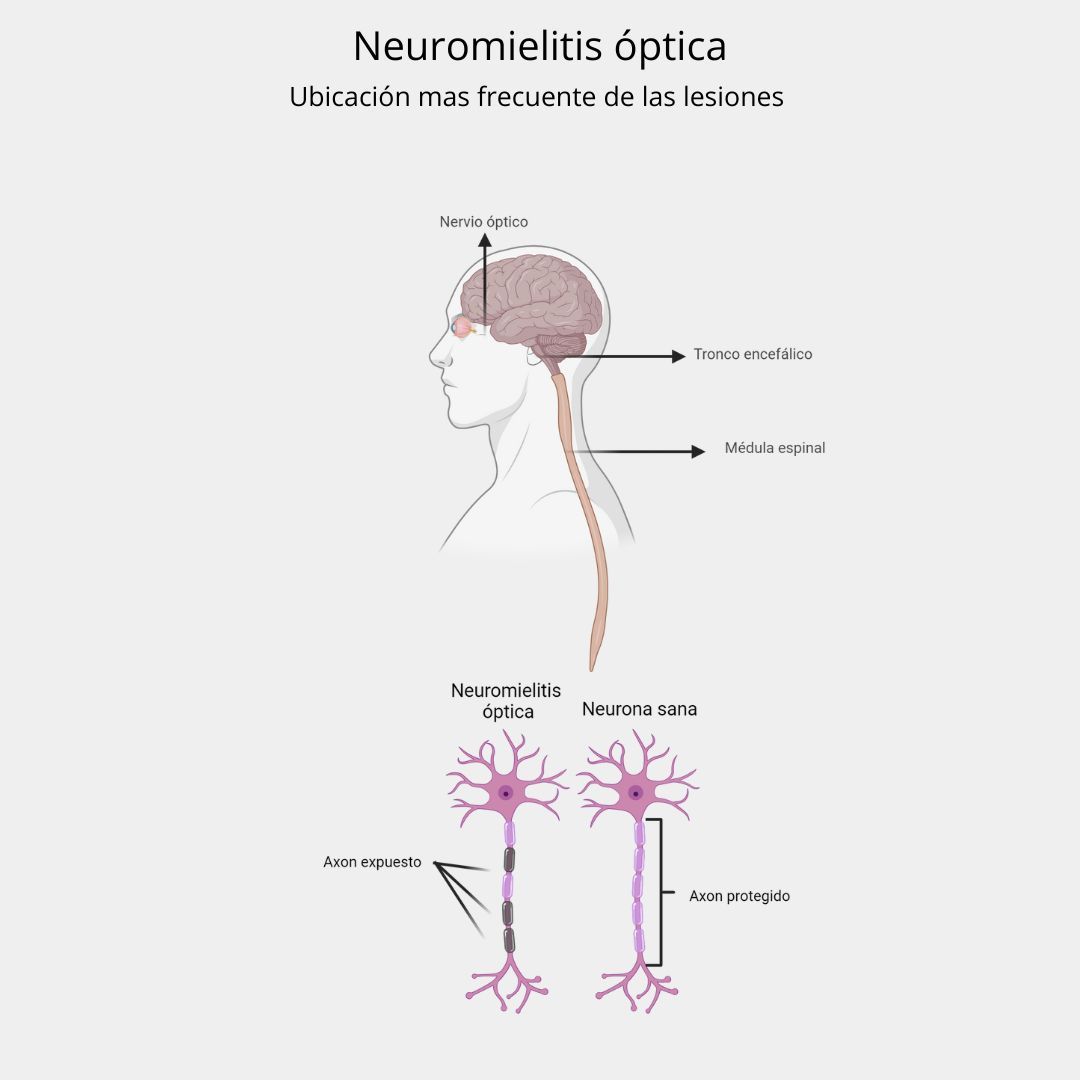
Neuromyelitis Optica (NMO) is an autoimmune disease affecting the central nervous system. Autoimmune pathologies are characterized by a disorder of the immune system that attacks organs or tissues as it would against aggressors. In NMO, the immune system attacks astrocytes, especially in the spinal cord and optic nerve. Astrocytes are cells of the central nervous system that support neurons and are essential for proper balance and brain function. Together with the rest of the cells that make up the neurology, astrocytes are necessary for the information that travels through the brain synapses to do so correctly, to provide nutritional support, as well as in the defense against aggressions.
Classically, NMO, also known as Devic’s disease, has been defined by the presence of anti-acuaporin 4 antibodies directed against astrocytes. Currently the term used is Neuromyelitis Optica Spectrum Disorders (NMOSD), which encompasses autoimmune inflammatory processes with predominant involvement of the spinal cord and optic nerves, with axonal damage and severe demyelination. Axonal damage consists of the loss of the neuronal connections responsible for the conduction of nerve impulses. Demyelination involves the loss of the protective layer of these connections, formed by myelin.
Among the demyelinating autoimmune diseases, Multiple Sclerosis is the most prevalent and well known, but there are other diseases such as NMO that also involve demyelination and are studied and treated in demyelinating disease units and clinics.
How long has the disease been known?
The first description of NMO was made by Eugene Devic with his disciple Fernand Gault through two publications in 1984 (1,2) and its dissemination at the French Congress of Medicine of the same year.
The concept of NMO has been evolving and the latest Neuromyelitis Optica Spectrum diagnostic criteria were published in 2015 (3).
At what age is it usually diagnosed?
Many studies place the average age of clinical debut at 40-41 years. Some series place the peak incidence/prevalence between 40 and 59 years of age. In any case, it can appear in children as well as in older people, being, compared to Multiple Sclerosis, a disease of later onset and diagnosis.
Is it a common disease?
In our environment it is not frequent. It is more common mainly in Asia, probably also in Africa and in African and Latin American populations.
In Europe, most publications place its prevalence below 1 case per 100,000 inhabitants. A study in Catalonia establishes the prevalence at 0.89 persons with NMOSD per 100,000 inhabitants (4).
How does it manifest itself? What are its symptoms?
It usually presents with outbreaks. They can be frequent or more sporadic, they are usually more severe than in other demyelinating diseases such as Multiple Sclerosis and the risk of sequelae is higher.
MYELITIS
Inflammation of the spinal cord (myelitis) is a common onset form. Some publications place it as the most frequent. It is a generally extensive inflammation that may present with weakness of the lower limbs or all four extremities, depending on whether the location is cervical or dorsal. Loss of sensibility in trunk and extremities, alteration in the control of the urinary sphincter and there can be pain. The pain is frequently intense, burning, with burning or stinging sensations. There is usually gait disturbance secondary to loss of strength and sensory disturbances.
Once the acute phase of the outbreak is over, it is common for spasticity problems to appear with residual weakness. Spasticity is a pathological increase in muscle tension, resulting from injury to the motor pathways, which can cause pain and functional limitation.
OPTIC NEURITIS
Inflammation of the optic nerve (optic neuritis) causes loss of visual acuity. The loss of vision may affect one or both eyes and is usually more severe and with worse recovery capacity than in Multiple Sclerosis. In the acute phase, along with the loss of vision, more intense eye pain with eye movements and photophobia appear. It is also common the alteration in the perception of colors, a phenomenon known as dyschromatopsia.
OTHER EVENTS
Area postrema syndrome
The postrema area is located in the lowest part of the brainstem, in the floor of the fourth ventricle, which is a space with cerebrospinal fluid that communicates with the ependymal canal of the medulla. Inflammation and injury in this area causes a typical picture of vomiting and hiccups that are difficult to manage. It may be the first manifestation of the disease in up to 11% of cases.
- Manifestations due to brainstem involvement. They may be similar to those of a Multiple Sclerosis outbreak, such as altered coordination of the limbs due to cerebellar syndrome or alterations in speech and swallowing, among other possible symptoms.
- Manifestations due to cerebral involvement. The presentation with weakness or loss of sensibility due to involvement of a cerebral hemisphere is unusual and not very specific of Neuromyelitis Optica Spectrum Disorder. There may be in some cases situations of encephalopathy due to severe acute involvement.
- Other symptoms.
Hypothalamic and diencephalic lesions cause drowsiness, narcolepsy, obesity, arterial hypotension, hypothermia or bradycardia.
What is its cause?
Neuromyelitis Optica Spectrum Disorders have an autoimmune origin. The immune system reacts virulently against the astrocyte, causing inflammation, demyelination and degeneration. There is probably a genetic predisposition. Epidemiological studies show a higher prevalence in regions with more population of Asian or African-American origin. Having another autoimmune disease such as systemic lupus erythematosus, thyroiditis, Sjogren’s syndrome, myasthenia gravis or psoriasis increases the risk. Little or nothing we know about possible environmental factors, which have been much more extensively studied in other demyelinating diseases such as Multiple Sclerosis.
Is it a hereditary disease?
It is not a hereditary disease. There could be a genetic predisposition, certain genetic variants in the major histocompatibility complex (HLA) would increase the risk. Neuromyelitis Optica Spectrum Disorders are more frequent in Asian countries and with African-American population.
How is it diagnosed?
In the presence of a compatible clinical picture such as rapid onset paraparesis, loss of vision with ocular pain or the appearance of vomiting and incoercible hiccups, the neurologist will request a brain and cervical and dorsal medulla MRI, without and with contrast. The imaging study may be completed with an MRI of the orbit.
If the MRI findings and clinical picture are compatible with NMOSD, the neurologist will continue the study with a lumbar puncture to analyze the cerebrospinal fluid, as well as an extensive blood test that should include anti-acuporin 4 antibodies, anti-MOG antibodies and a complete autoimmunity study.
New diagnostic criteria for Neuromyelitis Optica Spectrum Disorders were published in 2015. A typical clinical picture with positive anti-acuaporin 4 antibodies is diagnostic of NMOSD. If the antibodies are negative, other autoimmune and demyelinating diseases must be ruled out and additional radiological criteria must be met to ensure the diagnosis.
Do you have treatment?
As in other demyelinating diseases, there are no curative treatments, but there are drugs that improve the control and prognosis of people with Neuromyelitis Optica. These drugs act on the immune system modifying the course of the disease. Among the most commonly used in clinical practice are azathioprine and mycophenolate. Rituximab is a monoclonal antibody against B lymphocytes that express the CD-20 protein in their membrane and is used in both seropositive and seronegative NMOSD. Another option is tocilizumab, which blocks interleukin-6 (IL-6) receptors present on different types of T and B lymphocytes. In recent years, new more specific biologic treatments targeting NMOSD with positive anti-acuaporin 4 antibodies have appeared: these are eculizumab, satralizumab and inebilizumab.
Treatment of outbreaks
Outbreaks are treated with cycles of intravenous corticosteroids at high doses, generally for 5 days. In severe outbreaks it may be necessary to complete the treatment with plasmapheresis, which consists of a plasma exchange process that eliminates antibodies and proinflammatory elements from the blood circulation.
Symptomatic treatment
In addition to immunomodulatory treatment, the neurologist may consider other treatments aimed at controlling symptoms such as spasticity, pain, fatigue or urinary symptoms, as in other demyelinating disorders.
Forecast
The flare-ups in NMOSD are usually more severe and with a higher risk of sequelae than in other demyelinating processes. Therefore, the prognosis may be worse than in Multiple Sclerosis. The number of outbreaks during the first two years, the severity of the first episode and older age at diagnosis are factors of worse prognosis. Some studies indicate that black race may also be associated with a worse outcome.
An early diagnosis, a correct treatment of outbreaks to minimize as much as possible the risk of sequelae, an appropriate choice of immunomodulatory treatment and a prevention program with neuro-rehabilitation and non-pharmacological measures of integral health prevention, can help to improve the prognosis of Neuromyelitis Optica Spectrum Disorders, as well as the quality of life of people suffering from this pathology.
Bibliography
Devic E. Myélite aiguë compliquée de névrite optique. Bull Med (Paris) 1894; 8:1033.
Gault F. De la neuromyélite optique aiguë, Lyon 1894.
Wingerchuk DM et al. International consensus diagnostic criteria for neuromyelitis optica spectrum disorders. Neurology. 2015 Jul;85(2):177-89. Epub 2015 Jun 19.
Sepúlveda M et al. Epidemiology of NMOSD in Catalonia: Influence of the new 2015 criteria in incidence and prevalence estimates. Mult Scler. 2018 Dec;24(14):1843-1851.
Links of interest

Specialists
Meet our extensive team
What are we dealing with?
Specialized professionals
Request an appointment
Contact us