Primary progressive aphasia
GENERAL ASPECTS primary aphasia
What does “aphasia” mean?
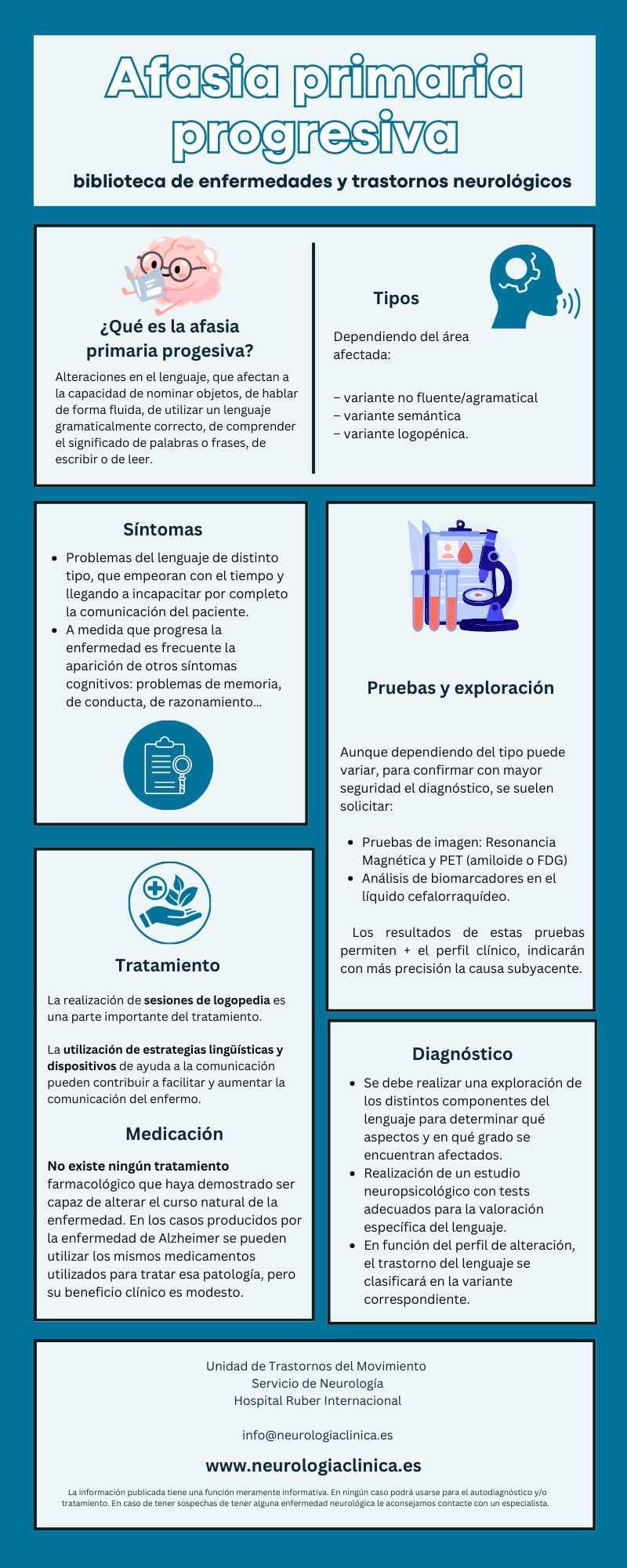
Aphasia is the medical term used to describe the existence of language disorders. These alterations can be very varied, and affect the ability to name objects, to speak fluently, to use grammatically correct language, to understand the meaning of words or phrases, to write or to read.
What diseases can cause aphasia?
Any lesion affecting the area of the brain responsible for language control can lead to aphasia. The most common causes are strokes, brain tumors, infections of the central nervous system and neurodegenerative processes.
What is primary progressive aphasia?
The term primary progressive aphasia is used when the language impairment (aphasia) is caused by a neurodegenerative process, and in turn, is the first and most relevant symptom of the disease. It is a descriptive term that, although it indicates that the cause is a neurodegenerative process, it does not specify exactly which one it is.
What symptoms are seen in a patient with primary progressive aphasia?
Language problems of different types (comprehension, fluency, grammaticality, naming, etc.) will be observed, which will worsen over time and may even completely disable the patient’s communication.
Often, as the disease progresses, other cognitive symptoms frequently appear: memory problems, behavioral problems, reasoning problems…
What types of primary progressive aphasia are there?
There are three types, depending on the language domains affected.
– Primary progressive aphasia, non-fluent/grammatical variant.
– Primary progressive aphasia, semantic variant.
– Primary progressive aphasia, logopenic variant.
What neurodegenerative processes can produce it?
As discussed above, the term primary progressive aphasia is a descriptive term for a set of symptoms (progressive language problems) caused by a neurodegenerative process. The neurodegenerative processes most frequently found behind primary progressive aphasia are Alzheimer’s disease and frontotemporal lobar degeneration.
What does the non-fluent/grammatical variant consist of?
There is above all a problem in the production of language. It may become agrammatical (i.e. telegraphic, with alterations in verb tenses, omission of articles or other syntactic structures), there may appear a slowing of the speech (which becomes slow, not very fluid, with blockages) and distortions may also appear in the pronunciation of complex words (which is called apraxia of speech).
What is the semantic variant?
Problems are observed especially with understanding the meaning of words. Surprisingly, sometimes there is more difficulty understanding a single word than a multi-word phrase. For example, the patient may have difficulty understanding terms such as “ocean”, “desert” or “cauliflower”. It is also often associated with problems finding the names of objects.
What does the logopenic variant consist of?
It is mainly characterized by the difficulty to find words when speaking and to name different objects, so it is common the existence of pauses while speaking and, sometimes, the change of one syllable for another (what are called “paraphasias”). Speech tends to become vague and sometimes empty of content, due to the tendency to use generic terms. There are also problems in repeating words and phrases.
How does it evolve?
Primary progressive aphasia is a manifestation of a neurodegenerative disease and, therefore, it is to be expected that language deficits will progressively worsen over time. In all three types of primary progressive aphasia, there may come a time when the patient is unable to communicate, both because of difficulty in uttering language and in understanding it. In addition, deficits may emerge in other cognitive spheres, such as memory or executive functions.
DIAGNOSIS
How is it diagnosed?
The most important thing is to perform an exploration of the different components of language to determine which aspects and to what degree are affected. It is important to carry out a neuropsychological study with appropriate tests for the specific assessment of language. Depending on the alteration profile, the language disorder will be classified in the corresponding variant.
What neurodegenerative diseases can cause aphasia?
Each of the different variables has a more probable cause. The logopenic variant is usually caused by Alzheimer’s disease, while the other two (non-fluent variant and semantic variant) are usually caused by Frontotemporal Lobar Degeneration. Therefore, the latter two are considered part of the Frontotemporal Dementia symptom spectrum.
How do you know for sure which disease is causing the aphasia?
Although, as we have said, each variant has a more probable cause, there is some overlap in the diseases that can produce them. To increase the degree of certainty about the disease causing the aphasia, complementary tests are usually performed, such as an MRI, a PET (amyloid or FDG) or an analysis of biomarkers in the cerebrospinal fluid. The results of these tests allow, together with the clinical profile, to determine more precisely the underlying cause.
TREATMENT
What is the treatment?
Speech therapy sessions are an important part of the treatment. The use of linguistic strategies and communication aids can help to facilitate and increase the patient’s communication.
Is there any medication capable of slowing down its evolution?
There is no pharmacological treatment that has been shown to be able to alter the natural course of the disease. In cases produced by Alzheimer’s disease, the same drugs used to treat that pathology can be used, but their clinical benefit is modest.

Specialists
Meet our extensive team
What are we dealing with?
Specialized professionals
Request an appointment
Contact us