
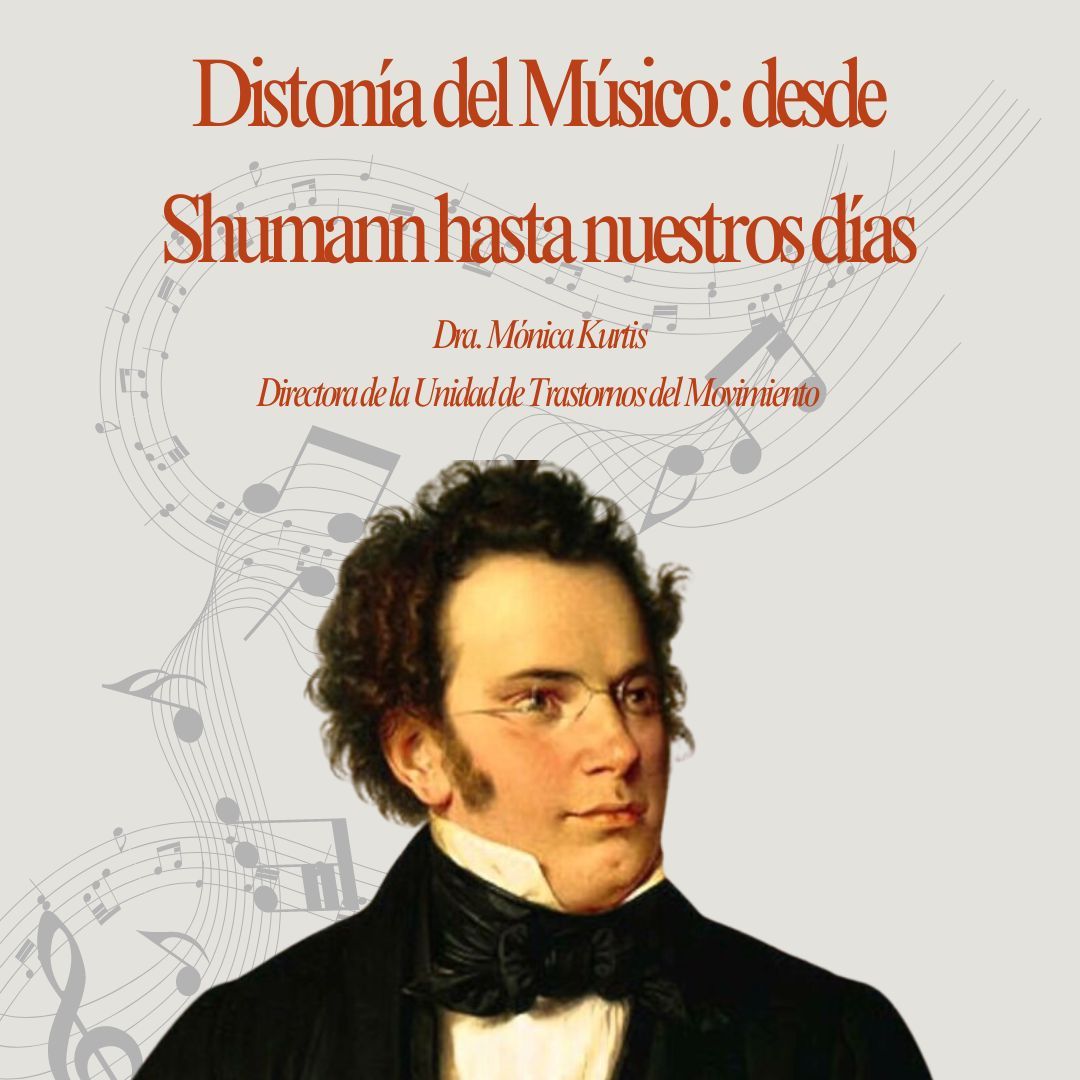
Musician’s dystonia: from Shumann to the present day.
He could never be like his admired Franz Liszt. The Saxon composer Robert Schumann (1810-1856), a key figure in the music of Romanticism, may have thought so when his career as a pianist was cut short by a right-hand disorder. At the age of seven Schumann composed his first musical pieces and at the age of fourteen he wrote an essay on the aesthetics of music. Undoubtedly, a child prodigy, admirer of the work of Paganini, Schubert or Mendelssohn, he had a dream: to be a pianist. During his youth his commitment was such that he even traveled accompanied by a keyboard. However, at the age of twenty a problem arose in his right hand that in the following years would cause him to abandon his career as a concert pianist. “When I move the fourth finger of my right hand, my whole body contorts,” he recounted in his diary. After the problems began, he struggled with his own hand, changed technique several times trying to improve the posture of his fingers, and used different prostheses that forced the fingers to extend backwards. His ability to play the piano fluctuated over time, with a tendency to worsen in times of stress, but he never stopped playing and was able to dedicate himself to composing until the end of his days. Schumann’s right hand disease could not be diagnosed in his time; but today, almost two hundred years later, with our current knowledge, many data indicate that it could be a dystonia of the musician (1).
What is musician’s dystonia?
Dystonia belongs to a group of neurological diseases called “movement disorders”. It is characterized by simultaneous involuntary contractions of agonist and antagonist muscles that may be sustained or spasmodic and cause abnormal postures or uncontrolled movements. Musician’s dystonia means that, when playing an instrument, there is a lack of motor coordination or a loss of voluntary control of highly trained movements. It is estimated that one out of every one hundred professional musicians is affected (2).
This type of dystonia is focal in that it affects only one part of the body. It is classified as task-specific or occupational because it manifests when playing an instrument. It is related to occupational activity and repetitive movements requiring dexterity. Players of stringed and percussion instruments often develop upper limb dystonia, as Schumann did when playing the piano. Wind players are also at risk for embouchure dystonia, which affects the coordination of the perioral, respiratory and lingual muscles.
What are the symptoms ?
The musician notices that he cannot play his instrument as before because he has lost control. Some musicians analyze their problem and, in explaining it, may describe which part of the arm or lips “does not do what I tell it to do”, bends or stretches or twists or opens, against its will. Dystonia most often affects the hand that is most in demand for playing the instrument. For keyboard and guitar players, it is the right hand. In the violin family, it is the left hand, since it holds the bow. The most frequent dystonic movement of the hand is forced flexion and the most affected fingers are usually the third (middle), fourth (ring) and fifth (little finger) (3). In wind, woodwind or brass instruments, the problem can be found in the embouchure. When the musician is observed playing, the alteration of the movement and the repercussion on the sound is visualized, which, depending on the severity, will be more or less appreciable.
Some players notice the symptoms suddenly and can remember exactly from what day they occurred and the piece they were playing. Others notice difficulties more insidiously and the symptoms appear, improve and reappear. In general, the evolution is progressive, so that the difficulties increase with the passing of weeks and months. The natural tendency of the musician, seeing his or her faculties diminished, is to dedicate more hours to rehearsal. However, repeated practice fails to overcome the problem and often leads to frustration and discouragement. Some musicians discover certain “tricks” that help them to overcome the problem and continue playing, such as changing the size of the mouthpiece, changing the grip or fixing the fingers with adhesive tape.
It is important to point out that dystonia does not usually appear with a very prominent pain, nor does it produce alterations in strength or sensory alterations; therefore, it can be distinguished from other common pathologies in musicians, such as: nerve compressions (for example, carpal tunnel syndrome), tendonitis, trigger fingers and muscle fatigue. As it is associated with a very specific task, those affected have no problems when doing other things and can write, type, eat, whistle, etc., without difficulties, and even if they play more than one instrument, they do not usually have problems with the second one.
Why does it happen?
The problem lies in the brain, not in the hand or mouth. From research studies in patients with dystonia and in animal models, it is known that the pathophysiological basis of dystonia involves increased erroneous brain activity and maladaptive plasticity. The cerebral cortex controlling the movement of the dystonic region (the arm in arm dystonia or the mouth in embouchure dystonia) is over-represented and de-differentiated. Therefore, when the subject gives the command to move only one muscle, a disproportionately large area of the sensory-motor cortex is activated, and moreover, in an exaggerated manner. The result is that more muscles are activated than those that voluntarily want to move, producing the abnormal postures and involuntary movements characteristic of dystonia (4).
What produces this excess brain plasticity?
The answer probably involves a combination of genetic and environmental factors (2). We know that there is a hereditary component because 10% of musicians have a family history and other focal dystonia is found in 23-27% of their first-degree relatives (5). In addition, there may be a hormonal or social component, because it is more frequent in males, with a ratio of 4:1 (3). There are other intrinsic factors of the individual that may favor the development of dystonia, such as, for example, triggering sensory alterations (local pain due to trauma or compression neuropathy) and an excessively anxious or perfectionist character. There are other external factors that possibly play a role and are related to the repeated practice of certain motor patterns. It is evident that each instrument requires a complexity of movements and work of different muscles, with its demands in terms of tempo (bow hand vs. neck hand in violin), space (high vs. low strings in guitar) and social expectations (more frequent in classical musicians than in jazz or rock).
How is it diagnosed?
Musician’s dystonia is a professional movement disorder little known in musical circles and under-diagnosed in medical circles. Very often, the affected musician consults multiple specialists, among them traumatologists, physiotherapists, rheumatologists and neurologists, before reaching a proper diagnosis. The first step in diagnosis is to see a neurologist specializing in movement disorders. A detailed personal and family history of the patient should be taken, including pharmacological history, triggering factors and a detailed description of the symptoms. In the clinical examination it is a priority to observe the musician playing his instrument so that the abnormal muscle contractions of the affected region can be objectified, as well as the degree of disability. This should be completed with a neurological examination to rule out the existence, or not, of other accompanying signs.
It is important to know that the diagnosis of musician’s dystonia is clinical, that is to say, it is based on the symptoms and signs presented by the affected person and their evolution. There is no complementary test that confirms or revokes the diagnosis of dystonia. In some cases, and always on an individual basis, it is necessary to request complementary brain neuoroimaging tests (anatomical and/or functional), spine, electromyography, electroencephalography, or analytical tests, to rule out secondary causes of dystonia.
How is it treated?
One of the first steps towards improvement is for the musician to understand what is happening to him/her; that what is happening has a name and a medical explanation. Once this is understood, the different treatment possibilities should be considered. The best therapy includes a combination of pharmacological and rehabilitative treatments. Medical treatment is based on the use of muscle relaxants and anticholinergic drugs, but probably the most effective tool is the infiltration of botulinum toxin. The neurologist injects this substance into the muscles affected by dystonia (always using electromyographic guidance) in order to relax them. The toxin acts locally, intercepting the message from the nerve to the muscle fiber and thus decreasing muscle contraction. In a large published series involving 84 musicians of different instruments, 69% noted improvement (6). In some patients the benefit can be as high as 80-90%. Embouchure dystonia is the only one that clearly does not respond to botulinum toxin.
Other interventions that can help the subject are based on musical “re-training”. Through training of the sensory-motor circuits, changes in technique, immobilizations, use of sensory tricks (adaptations of claves, mouthpieces, splints) and relaxation techniques, the musician can improve his or her playing control. However, despite the objective improvement with treatments, most affected musicians do not manage to return to their musical level prior to the onset of dystonia and are forced to rethink their musical career towards teaching, research or composition.
In conclusion
Musician’s dystonia is a complex neurological disease that affects 1% of professional musicians, yet it is little known in musical and medical circles. For the affected musician, reaching a diagnosis is of vital importance because it can avoid surgery and inadequate treatment, as well as saving a lot of frustration and wasted time. Current treatments may be partially effective but are often far from achieving the perfection required by a professional musician. Hopefully, increasing research into the underlying causes of dystonia will open the door to new therapies in the future.
Bibliography:
- García de Yébenes J. Did Robert Schumann have dystonia? Mov Disord. 1995;10(4):413-7.
- Altenmüller E, Jabusch HC. Focal hand dystonia in musicians: phenomenology, etiology,and psychological trigger factors.J Hand Ther.2009;22(2):144-54.
- Conti AM,Pullman S,Frucht SJ.The hand that has forgotten its cunning-lessons from musicians’ hand dystonia. Mov Disord. 2008;23(10):1398-406.
- Quartarone A, Siebner HR,Rothwell JC.Task-specific hand dystonia: can too much plasticity be bad for you? Trends Neurosci. 2006;29(4):192-9.
- Schmidt A,Jabusch HC,Altenmüller E,Hagenah J,Brüggemann N,Lohmann K,Enders L,Kramer PL,Saunders-Pullman R,Bressman SB,Münchau A,Klein C.Etiology of musician’s dystonia: familial or environmental? Neurology. 2009;72(14):1248-54.
- Schuele S, Jabusch HC, Lederman RJ, Altenmüller E. Botulinum toxin injections in the treatment of musician’s dystonia. Neurology. 2005;64(2):341-3.

Dr. Monica Kurtis
Director of the Movement Disorders Unit