NEUROLOGICAL EMERGENCIES
An acute neurological disorder (sudden onset) needs to be evaluated in a hospital setting by a neurologist as soon as possible. In neurology, time is of the essence, and every minute that passes can be critical in the care of a patient. Time is brain. Acting in the best possible time in neurological medical emergencies has been shown to significantly improve the patient’s prognosis. Sub-acute neurological disorders (onset within days/weeks) should also be evaluated without delay.
The most frequent causes of neurological emergencies are ischemic or hemorrhagic stroke, headaches, and epileptic seizures. Up to 10-15% of hospital emergencies are neurological.
Being aware of the importance of being able to diagnose and choose the best therapeutic option in these cases, from the beginning of the activity of the Neurology Service of the Ruber International Hospital (1986), urgent neurological care has been assured.
Neurological emergencies include patients presenting to the hospital with an acute or subacute neurological disorder, and inpatients presenting with a reason for urgent neurological hospital consultation.
A neurological emergency requires a rapid, coordinated and effective response from the neurological team in order to avoid irreversible sequelae or death of the patient.
In this sense, we attend patients who present decreased level of consciousness, headache, language alteration, loss of strength, altered sensibility, or difficulty standing or walking. These symptoms may be the manifestation of an ischemic or hemorrhagic stroke, a migraine attack, a heart block or an infection of the nervous system, among many other possibilities.
The data obtained from the clinical history and examination will allow us to know whether the neurological disorder presented by a patient is due to cerebral, brainstem, cerebellar or spinal cord involvement.
In the case of diffuse cerebral involvement, the disorder is usually toxic, metabolic, infectious, hypoxic or traumatic. The most frequent clinical picture is acute confusional syndrome. Age and other factors may predispose to such a situation. More severe involvement due to the same causes may lead to coma.
Another situation is intermittent loss of consciousness, either for the first time or recurrent. These are called paroxysmal episodes characterized by an abrupt onset, usually of short duration and often repeated. These cases may correspond mainly to syncope or epileptic seizures. They may also be due to transient ischemia or migraine.
When the clinical data provided by the patient and companions, and evidenced in the neurological examination are compatible with the disorder of a specific area of the brain, we consider it as a focal brain involvement. In these cases the patient may present language, visual, motor and/or sensory disturbances. Ischemic or hemorrhagic strokes, tumors and other types of localized lesions may manifest themselves in this way.
Other times the patient presents with motor and/or sensory symptoms and signs suggestive of neuromuscular disease.
Early neurological care determines patient prognosis
NEUROLOGICAL EMERGENCIES
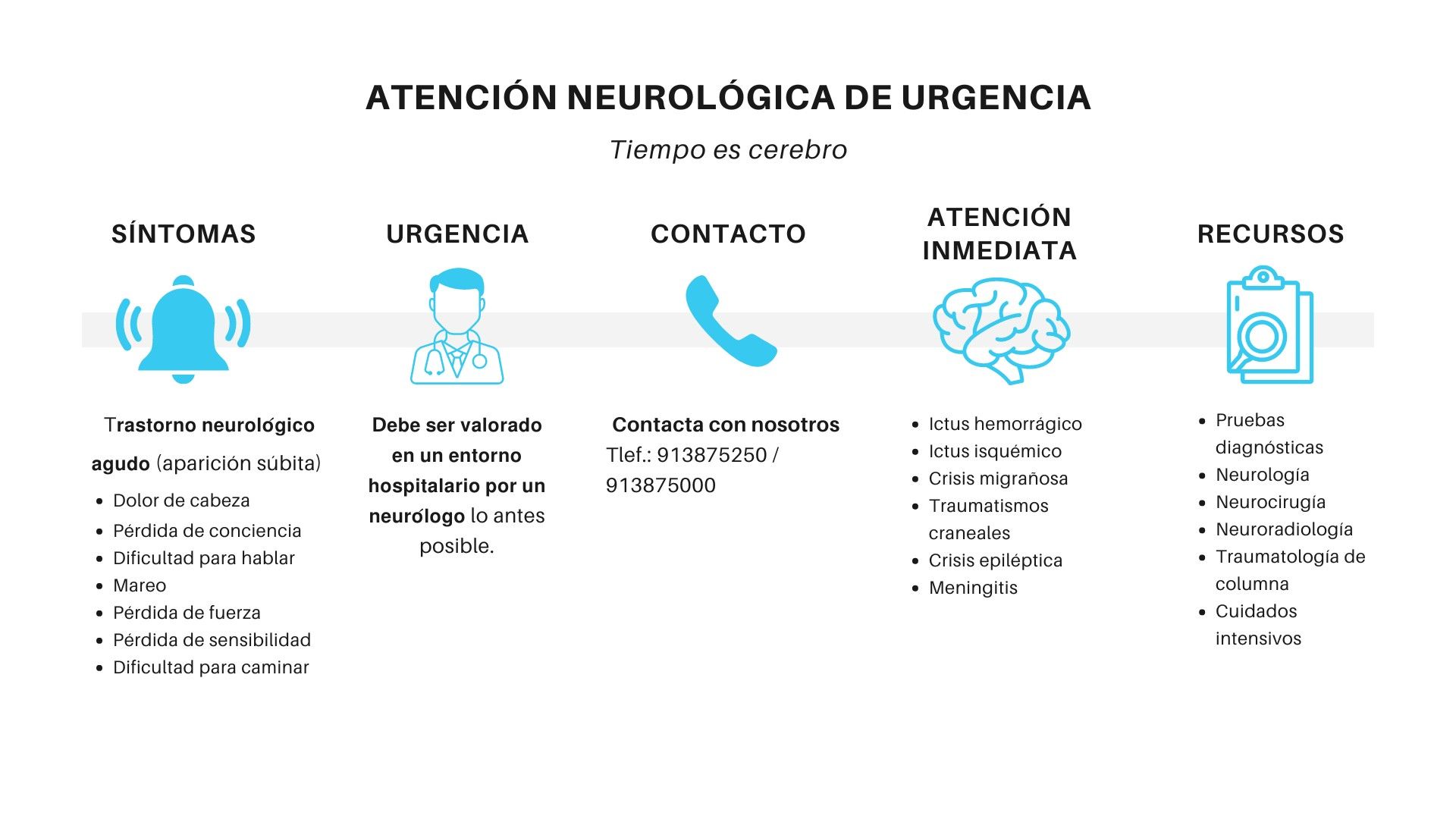
An acute neurological disorder (sudden onset) needs to be evaluated in a hospital setting by a neurologist as soon as possible. In neurology, time is of the essence, and every minute that passes can be critical in the care of a patient. Time is brain. Acting in the best possible time in neurological medical emergencies has been shown to significantly improve the patient’s prognosis. Sub-acute neurological disorders (onset within days/weeks) should also be evaluated without delay.
The most frequent causes of neurological emergencies are ischemic or hemorrhagic stroke, headaches, and epileptic seizures. Up to 10-15% of hospital emergencies are neurological.
Being aware of the importance of being able to diagnose and choose the best therapeutic option in these cases, from the beginning of the activity of the Neurology Service of the Ruber International Hospital (1986), urgent neurological care has been assured.
Neurological emergencies include patients presenting to the hospital with an acute or subacute neurological disorder, and inpatients presenting with a reason for urgent neurological hospital consultation.
A neurological emergency requires a rapid, coordinated and effective response from the neurological team in order to avoid irreversible sequelae or death of the patient.
In this sense, we attend patients who present decreased level of consciousness, headache, language alteration, loss of strength, altered sensibility, or difficulty standing or walking. These symptoms may be the manifestation of an ischemic or hemorrhagic stroke, a migraine attack, a heart block or an infection of the nervous system, among many other possibilities.
The data obtained from the clinical history and examination will allow us to know whether the neurological disorder presented by a patient is due to cerebral, brainstem, cerebellar or spinal cord involvement.
In the case of diffuse cerebral involvement, the disorder is usually toxic, metabolic, infectious, hypoxic or traumatic. The most frequent clinical picture is acute confusional syndrome. Age and other factors may predispose to such a situation. More severe involvement due to the same causes may lead to coma.
Another situation is intermittent loss of consciousness, either for the first time or recurrent. These are called paroxysmal episodes characterized by an abrupt onset, usually of short duration and often repeated. These cases may correspond mainly to syncope or epileptic seizures. They may also be due to transient ischemia or migraine.
When the clinical data provided by the patient and companions, and evidenced in the neurological examination are compatible with the disorder of a specific area of the brain, we consider it as a focal brain involvement. In these cases the patient may present language, visual, motor and/or sensory disturbances. Ischemic or hemorrhagic strokes, tumors and other types of localized lesions may manifest themselves in this way.
Other times the patient presents with motor and/or sensory symptoms and signs suggestive of neuromuscular disease.
COMPLEMENTARY TESTS
The performance of complementary tests in neurological emergencies is essential for the diagnosis of urgent neurological disease and decision making regarding treatment.
The choice of the appropriate tests in each case is made on the basis of the clinical picture presented by each patient. The availability and interpretation of the necessary tests for any neurological emergency are permanently available.
Head and spine imaging studies
Computed axial tomography (CT) of the brain and spine
Computed axial tomography (CT angiography) of cerebral and cervical arteries.
Magnetic resonance imaging (MRI) of head and spine
Magnetic resonance angiography (MRA) of cerebral and cervical arteries.
Ultrasound study (Doppler ultrasound) of cervical and cerebral arteries.
Cerebral, cervical and spinal arteriography
Electroencephalogram for the recording of brain electrical activity.
Lumbar puncture to obtain cerebrospinal fluid for analysis.
MOST FREQUENT NEUROLOGICAL EMERGENCIES
- Ischemic or hemorrhagic stroke
- Headache
- Epileptic seizures
- Loss of consciousness
- Confusion
- Dizziness/vertigo
- Cranial traumas
- Central nervous system infections
COMPLEMENTARY SPECIALTIES
In addition, we have the participation of all the medical specialties necessary to be able to attend patients in these circumstances:
- Neurology
- Neurosurgery
- Neuro-radiology
- Interventional neuro-radiology
- Spinal traumatology
- Intensive Care