
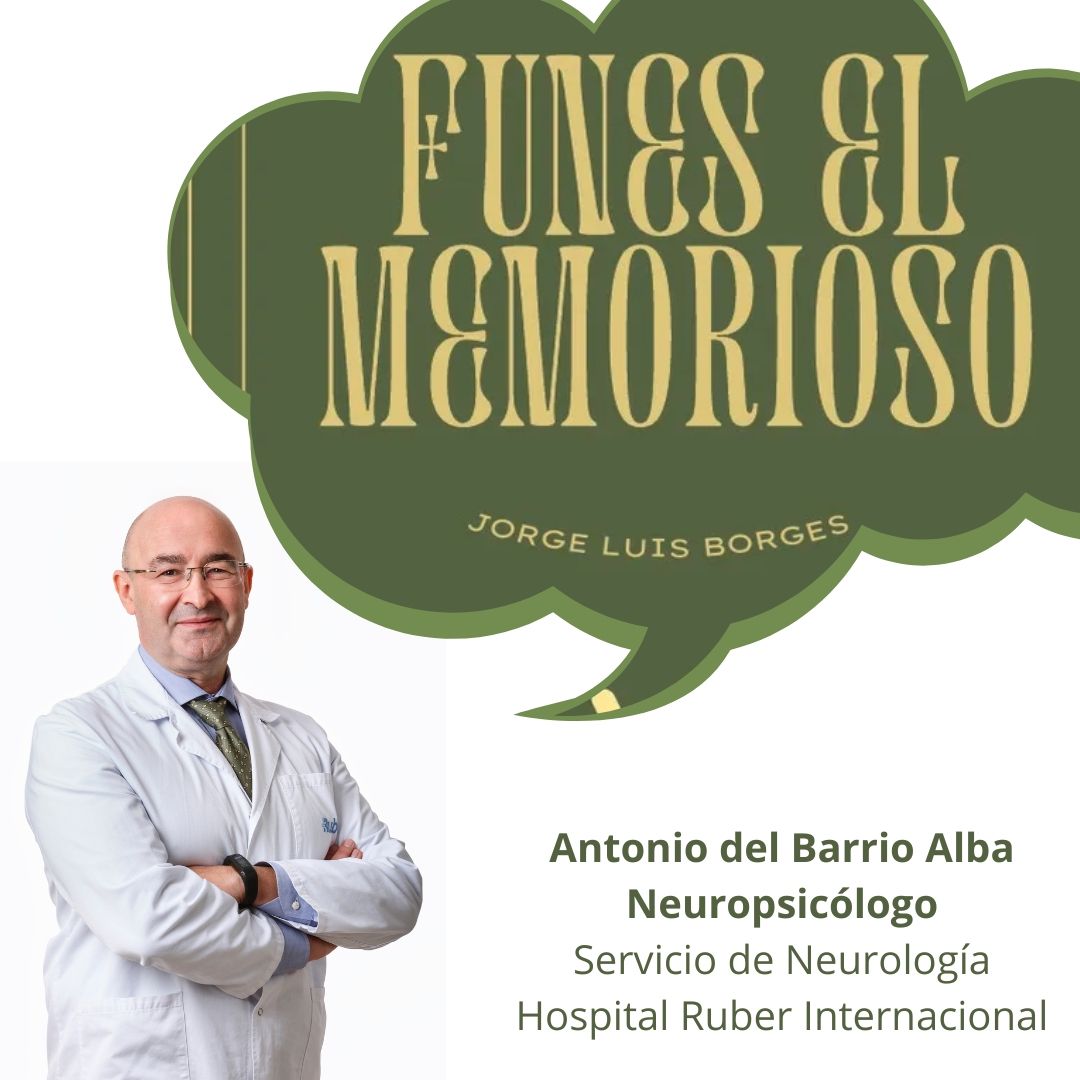
Title: “Tracing the limits of memory: From Funes the Memorious to Jennifer Aniston’s neurons”.
Author, Antonio del Barrio Alba, neuropsychologist of the Neurology Service, Hospital Ruber Internacional.
Neuroscience reveals that our mind tends to discard a surprising amount of detail, retaining only abstract and meaningful memories. This selective memory process is influenced by various factors, such as familiarity or emotions associated with an event.
In his emblematic story “Funes el memorioso” Jorge Luis Borges narrates the life of Ireneo Funes, a young man with a prodigious memory. After an accident, Funes develops an extraordinary ability to remember every detail of his life and everything he experiences. This ability leads him to perceive the world in a completely different way, but it also plunges him into a deep unhappiness as he is unable to filter or forget any sensation or experience. Through Funes’ story, Borges explores themes such as perception, memory, identity and the limits of human knowledge.
Memory, according to neuroscience, is a creative process rooted in personal experience. We tend to process only a tiny fraction of the information we receive, focusing on what we consider relevant. From this limited information, we create concepts and memories, discarding the rest.
The famous discovery of the “Jennifer Aniston neuron” by neuroscientist Rodrigo Quian Quiroga and his team in 2005 highlights the specialization and selectivity of individual neurons. They observed that one neuron was consistently activated by stimuli related to the actress, suggesting how the brain organizes and processes information through specific neural connections. These neurons are located in the hippocampus.
The hippocampus, a crucial component of the brain, facilitates the connection between perception and memory, contributing to the abstraction of concepts needed to store memories. The ability to abstract involves forgetting irrelevant details, an essential process in memory formation.
Two fundamental principles of thought and memory are abstraction and forgetting. The ability to generate meanings and associations between concepts is essential for the storage of memories, while selective forgetting allows maintaining clarity and relevance in memory.
Having said all this, if forgetfulness is part of memory, we can ask ourselves when memory loss is considered serious or clinically relevant.
Memory loss is considered severe when it interferes with daily activities and cognitive functions. Indicators such as difficulty retaining recent information or forgetting basic details may point to underlying medical conditions that require specialized attention and treatment.
In summary, the study of memory from literature to neuroscience offers a fascinating insight into how we perceive and remember the world around us, highlighting the complexity and importance of this fundamental cognitive process.

Antonio del Barrio Alba
Neuropsychologist